Air Abrasion: Complete Guide to Minimally Invasive Dentistry
Table of Contents
- Understanding Air Abrasion in Dentistry
- How Air Abrasion Works for Cavity Treatment
- Air Abrasion vs. Traditional Drilling
- Getting Air Abrasion Treatment in London, Ontario
- The Role of Air Abrasion in Minimally Invasive Dentistry
- Frequently Asked Questions About Air Abrasion
- A Gentle Option for Your Next Filling
Understanding Air Abrasion in Dentistry
One of the key techniques we use to minimize discomfort is air abrasion. This drill-free method uses a stream of compressed air and fine abrasive particles—typically aluminum oxide—to gently remove tooth decay without the vibration, heat, or noise of a traditional drill. As our minimally invasive care page explains, it is a quiet, conservative approach designed for small cavities that preserves more of your natural tooth structure.
With air abrasion, we can treat small cavities, prepare teeth for sealants, and ready surfaces for bonding or veneers—often without the need for local anesthesia. As our patient FAQ explains, the treatment is so comfortable that many patients don’t need numbing, and it feels more like a gentle spray than a drill. Because it conserves more healthy tooth structure, it is a perfect example of minimally invasive dentistry in action.
Air abrasion is not suitable for large, deep cavities or areas near the gum line where moisture can interfere. For certain situations, we may recommend silver diamine fluoride instead, but air abrasion remains a cornerstone of our gentle care approach. Because air abrasion conserves tooth structure, it is frequently used in our cosmetic dentistry services for preparation of veneers and composite bonding. As part of our award-winning gentle care, air abrasion helps us treat patients of all ages with minimal stress. Air abrasion opens the door to truly conservative treatment, which we’ll explore next in our bonding and sealants options.
How Air Abrasion Works for Cavity Treatment
Air abrasion is a gentle, drill-free method we use to treat cavities at our London, ON clinic. As part of our commitment to minimally invasive dentistry, this approach allows us to remove decay while preserving as much healthy enamel as possible. The procedure is quiet, vibration-free, and often reduces the need for local anesthesia, making it an excellent choice for patients who feel anxious about traditional drilling.
The technique works by directing a precise stream of fine particles—typically aluminum oxide—against the decayed area using compressed air. This abrasive flow gently erodes damaged tissue without generating heat or pressure, so there is none of the vibration or noise associated with standard drills. A specialized handpiece contains both the nozzle for the particle stream and integrated suction that instantly captures debris, keeping the treatment site clean and comfortable. The FDI World Dental Federation recognizes air abrasion as a minimally invasive option widely accepted for treating small cavities and early decay.
Because the stream is so targeted, we can remove only the softened, decayed tooth structure while leaving surrounding healthy enamel intact. This precision makes it ideal for small to moderate cavities, root surface caries, and areas accessible by the nozzle. Large or deep cavities that extend well into the tooth may still require a traditional drill, but we always discuss the best option for your situation.
During your visit, our team takes several steps to ensure your comfort. We place protective eyewear and, when appropriate, a small suction or rubber dam to isolate the tooth. Then we apply the air-abrasive stream in short, controlled bursts, pausing frequently to inspect the area and verify that all decay has been removed. The entire process often eliminates the need for anesthetic, so you can leave our office without lingering numbness and return to your daily routine right away.
Air abrasion reduces anxiety for children and adults alike—there is no loud drilling sound, no uncomfortable vibration, and no feeling of pressure. Alongside other conservative options like silver diamine fluoride, this technique helps us stop decay early while maintaining the strength of your tooth. At Smilo Family Dental, we believe that cavity treatment should be as stress-free as possible, and our use of air-abrasive technology reflects that commitment.
After the air-abraded area is cleaned and prepared, we can often complete the restoration with a tooth-coloured filling or bonding, which we’ll cover next. This seamless workflow supports our mission of delivering gentle, family-focused dental care that respects your time and comfort. Our goal is to provide effective treatment that leaves your smile healthy and your experience positive.
Air Abrasion vs. Traditional Drilling
To fully appreciate air abrasion, it helps to compare it with the traditional drill that most people are familiar with. At Smilo Family Dental, we embrace minimally invasive dentistry as a cornerstone of gentle, family-focused care. Air abrasion technology offers a quiet, precise alternative for treating small to moderate cavities, often without the need for a dental drill or local anesthetic. This section explains how the particle-stream method works and highlights the key differences that make it an appealing choice for many patients. We will look at the mechanism, patient experience, and the clinical outcomes that set these two approaches apart.
Mechanism of Air Abrasion: Particle Stream and Cavity Preparation
Air abrasion harnesses a controlled stream of compressed air that propels fine aluminum oxide or silica particles toward the tooth surface. These particles, which feel like a gentle sprinkle of fine sand, effectively abrade decayed enamel and dentin without any rotating burs. Because there is no mechanical friction, the procedure generates no heat and minimal vibration, a stark contrast to the warmth and buzzing produced by traditional drills. The particle stream selectively removes only soft, decayed tissue while leaving healthy enamel largely intact, so many patients describe the sensation as little more than a tickling puff of air. Dust and debris are managed with an efficient suction system, keeping the treatment area clean and visible for the dentist. This precision often eliminates the need for local anesthesia, making the experience more comfortable for both adults and children. According to restorative dentistry guidelines published by the FDI World Dental Federation, particle-stream techniques like air abrasion are an accepted method for conservative cavity preparation, supporting our own commitment to gentle, minimally invasive care. At Smilo Family Dental, we use air abrasion as part of our preventive and restorative lineup to treat small cavities, apply sealants, and prepare teeth for bonding.
Key Differences Between Air Abrasion and Conventional Drilling
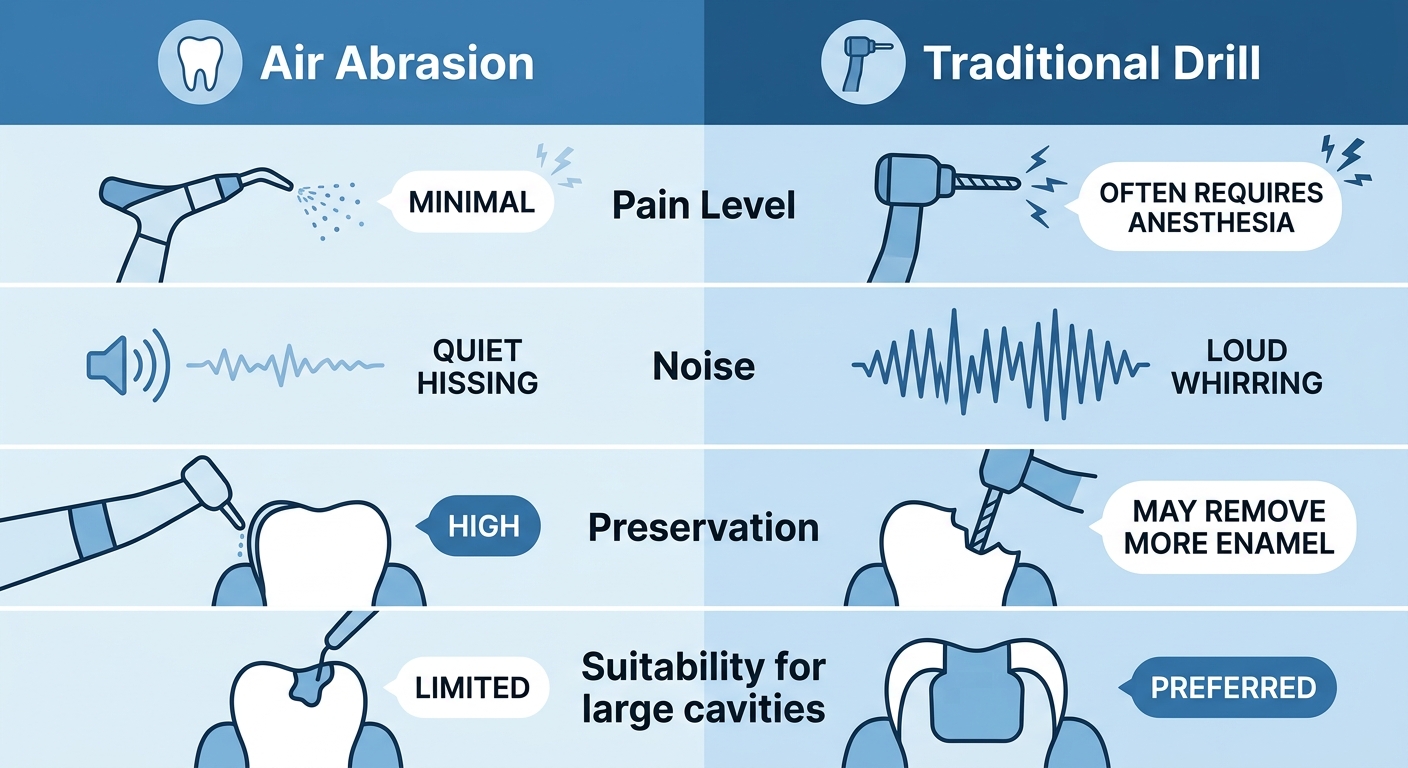
The most noticeable difference for patients is the sound. Air abrasion produces a quiet hissing noise rather than the loud whirring of a traditional drill. This calmer environment can make dental visits less anxiety-provoking, especially for children or anyone with dental fear. Because the particle stream generates no heat or vibration, many treatments require no local anesthetic, whereas drilling typically involves a numbing injection. From a clinical perspective, air abrasion preserves significantly more healthy tooth structure because it targets only decayed tissue. In contrast, conventional drilling may remove additional healthy enamel to create a suitable shape for filling material. This precision supports our commitment to minimally invasive dentistry. However, air abrasion does have limitations: it is best suited for small to moderate cavities and may not be ideal for deep decay or large restorations, where a traditional drill remains the preferred tool. For certain small lesions, treatments like silver diamine fluoride may also be considered. Our use of air abrasion complies with dental regulation in Ontario, ensuring safety for every patient.
Air abrasion vs. traditional drilling: a side-by-side dental comparison
These differences are not just theoretical; they translate directly into a more comfortable patient experience and more conservative dental treatment for our London community. Understanding the trade-offs helps our team recommend the right approach for your unique smile.
The table below summarizes the main differences.
| Aspect | Air Abrasion | Traditional Drill |
|---|---|---|
| Pain Level | Typically minimal or none | Often requires local anesthesia |
| Noise | Quiet, gentle hissing sound | Loud whirring and drilling |
| Preservation of Healthy Structure | High; targets only decayed tissue | May remove more healthy enamel |
| Suitability for Large Cavities | Limited; best for small to moderate cavities | Preferred for extensive decay |
At Smilo Family Dental, we integrate air abrasion into our comprehensive minimally invasive care for qualifying patients, always guided by the highest regulatory standards set by the Royal College of Dental Surgeons of Ontario. Understanding these differences can help you feel more confident about your next filling appointment.
Getting Air Abrasion Treatment in London, Ontario
Now that you understand the advantages of air abrasion, here’s what to expect when getting treatment in London, Ontario. Modern restorative dentistry education emphasizes tooth-preserving techniques, and air abrasion is a prime example of minimally invasive care. At Smilo Family Dental, we’re proud to offer this gentle approach as part of our comprehensive dental services.
The Air Abrasion Procedure: Step by Step
A typical air abrasion appointment is straightforward and comfortable. According to our procedure FAQ, here’s how we guide you through the process:
- Diagnostic imaging: We begin with digital X-rays to precisely assess the cavity’s size and location. This helps us plan the most conservative treatment.
- Isolation: A small rubber dam or other barrier is placed to keep the area dry and protect your cheek and tongue. Nothing sharp touches your tooth at this stage.
- Particle stream decay removal: A focused stream of tiny aluminum oxide particles gently blasts away decayed tissue. Because this process avoids heat, vibration, and pressure, most patients need no anesthetic. You’ll feel only a light spray, and we continuously suction away debris.
- Bonding application: Once the cavity is clean, we apply a tooth-colored composite filling that bonds directly to the remaining healthy structure. Air abrasion leaves a microscopically roughened surface, which helps the filling adhere exceptionally well.
- Post-treatment care: You can eat and drink right away. We’ll give you simple care instructions and answer any questions. There’s no numbness, so you can return to your day immediately.
Because air abrasion removes only the decayed portion, it conserves significantly more healthy enamel than traditional drilling. This makes it an ideal option for small to moderate cavities, especially for patients who dread needles or the sound of a drill.
Cost and Insurance Considerations for Air Abrasion
At Smilo Family Dental, we believe that cost should never stand in the way of comfortable, minimally invasive care. Our cost FAQ explains that air abrasion fillings are custom-quoted during your consultation because every cavity is unique. In many cases, the fee is comparable to a standard filling, and most dental insurance plans treat air abrasion as a routine restorative procedure. For your convenience, we offer direct billing and flexible payment plans so you can focus on your smile, not the paperwork. As we like to say: Flexible payments, stress-free insurance.
| Treatment | How It Works | Best For | Cost Estimate | Pain Level |
|---|---|---|---|---|
| Air Abrasion | Particle stream removes decay | Small to moderate cavities | Varies by clinic | Minimal to none |
| Silver Diamine Fluoride (SDF) | Liquid applied to arrest decay | Non-invasive, high-risk patients | Lower cost | None |
| Traditional Drilling | Rotary bur removes decay | Large cavities | Standard fee | May require anesthesia |
Air abrasion offers a near-painless experience and preserves healthy tooth structure, making it an excellent choice for early decay. Silver diamine fluoride is a non-invasive option that can stop decay without any drilling at all—ideal for children or special-needs patients—though it may darken the treated area. Traditional drilling remains the most versatile for large or deep cavities. Your dentist will help you decide which method fits your needs and budget. Now that you know how treatments compare, let’s look at how to find a provider near you.
Finding Air Abrasion Providers in London, Ontario
Searching for air abrasion treatment is easier than you might think. Start by looking online for “minimally invasive dentistry London Ontario” or “air abrasion London Ontario.” When you find a clinic, visit for a consultation armed with a few key questions:
- “Do you use air abrasion for small cavities?”
- “How do you manage patient comfort during the procedure?”
- “What is the estimated cost after insurance, and do you offer flexible payment options?”
At Smilo Family Dental, we’re happy to answer all of these. Our team is trained in gentle, minimally invasive techniques that leave more of your natural tooth intact. We’ve helped thousands of patients experience stress-free dental care—Gentle care, for every generation.
Beyond the questions, ask about the equipment the practice uses. Modern air abrasion units are precise and quiet; a clinic that invests in this technology shows a commitment to your comfort. Also, confirm that the dental team has experience applying tooth-colored fillings after air abrasion, as the bonding process requires special attention to surface preparation. Read reviews from other patients in London, Ontario who have undergone air abrasion to get a real-world sense of what to expect. Finally, you can book a consultation at our Hyde Park office by calling (519) 474-0220 or using our online scheduler. We’ll provide a custom treatment plan and a clear cost estimate after your exam.
The Role of Air Abrasion in Minimally Invasive Dentistry
Air abrasion is a gentle, drill-free method that uses a stream of fine particles to remove early-stage tooth decay. Rather than using a traditional dental drill, air abrasion relies on a gentle spray of tiny aluminum oxide particles to precisely remove decay without vibration or heat. This technique is a cornerstone of the minimally invasive dentistry philosophy we follow, allowing us to treat cavities while preserving as much healthy tooth structure as possible.
Because the air abrasion system targets only decayed enamel, it removes significantly less healthy tooth structure compared to conventional methods. The fine particles used are safe and effective for removing early cavities while leaving surrounding enamel intact. This precision supports our minimally invasive approach and helps maintain your natural tooth strength. The stream of particles gently cleans the preparation site, allowing us to place fillings, sealants, or bonding materials with exceptional accuracy. In many cases, the process is quieter and may reduce or even eliminate the need for local anesthesia, contributing to a more relaxed experience. For many patients, this means a shorter appointment and a comfortable visit without the sound of a drill. We integrate air abrasion as part of our commitment to evidence-based, conservative dentistry—a standard upheld by the Royal College of Dental Surgeons of Ontario.
This drill-free approach is particularly well suited for treating small cavities and preparing teeth for sealants or composite bonding. The gentle cavity treatment preserves the tooth’s integrity while minimizing discomfort. It also works well for smoothing tooth surfaces before cosmetic restorations, ensuring a precise bond. Because air abrasion minimizes vibration and heat, many patients find the experience more comfortable than traditional methods, and in some cases, local anesthesia may not be needed. However, comfort levels can vary, and we always tailor our approach to your individual needs to ensure you feel at ease.
At Smilo Family Dental, our commitment to gentle, family-focused care means we embrace techniques like air abrasion that prioritize your comfort and long-term oral health. By combining drill-free decay removal with a conservative treatment mindset, we help every patient—from children to seniors—maintain strong, healthy smiles. We invite you to discover how this approach can transform your dental visits into a calm, positive experience. It’s all part of our Gentle care, for every generation promise.
Frequently Asked Questions About Air Abrasion
Still have questions? Here are answers to some of the most common ones.
- What is air abrasion? Air abrasion is a drill-free technique that uses a fine stream of air and tiny particles to gently remove early tooth decay. This approach preserves more of your healthy tooth structure than traditional drilling.
- Does air abrasion hurt? Because this drill-free approach is minimally invasive, most patients do not require anesthesia. The procedure produces little to no discomfort, and the sound is much quieter than a dental drill.
- How does air abrasion differ from a traditional drill? This gentle method removes decay without the vibration, heat, or pressure of a drill. It requires no needles for most patients and is quieter, making it ideal for those who feel anxious about traditional fillings.
- Who is a good candidate for air abrasion? Air abrasion is ideal for small cavities, repairing old composite resin fillings, and preparing teeth for sealants or bonding. It fits perfectly with our philosophy of minimally invasive dentistry.
A Gentle Option for Your Next Filling
For those who dread the drill, we offer an even gentler option: air abrasion. This technique uses a fine stream of aluminium oxide particles to remove decay without the heat, vibration, or noise of a traditional drill. It often requires no anaesthetic, making it ideal for needle anxiety or small cavities. The air abrasion technique preserves more natural tooth structure, aligning with our commitment to minimally invasive dentistry. The procedure is quick, comfortable, and reflects our ‘Gentle care, for every generation’ approach at Smilo Family Dental. Ask us about air abrasion at your next visit.
This article was researched and written with the assistance of AI tools.
Resources
- Get Bespoke Cosmetic Dentistry Services for a Radiant Smile
- Preserve Natural Teeth with Minimally Invasive Dentistry
- Read the Educational Guide on Minimally Invasive Dentistry
- Get Comprehensive Family Dental Care with a 4.8-Star Rating
- Learn How to Choose a Family Dental Care Provider
- Compare Dental Implants and Dentures for Better Smile Choice
- Experience Family Dental Care for All Life Stages
- Check Dentist Credentials on the RCDSO Online Register
- Get Informed on Restorative Dentistry from FDI Experts